

Should You Wait for a Cataract to “Ripen”?

What Happens When Cataract Surgery Is Delayed Too Long? Clinical Consequences and Surgical Risk
Author: Dr. Risto Traykovski,
ophthalmologist at Pentagram Eye Hospital
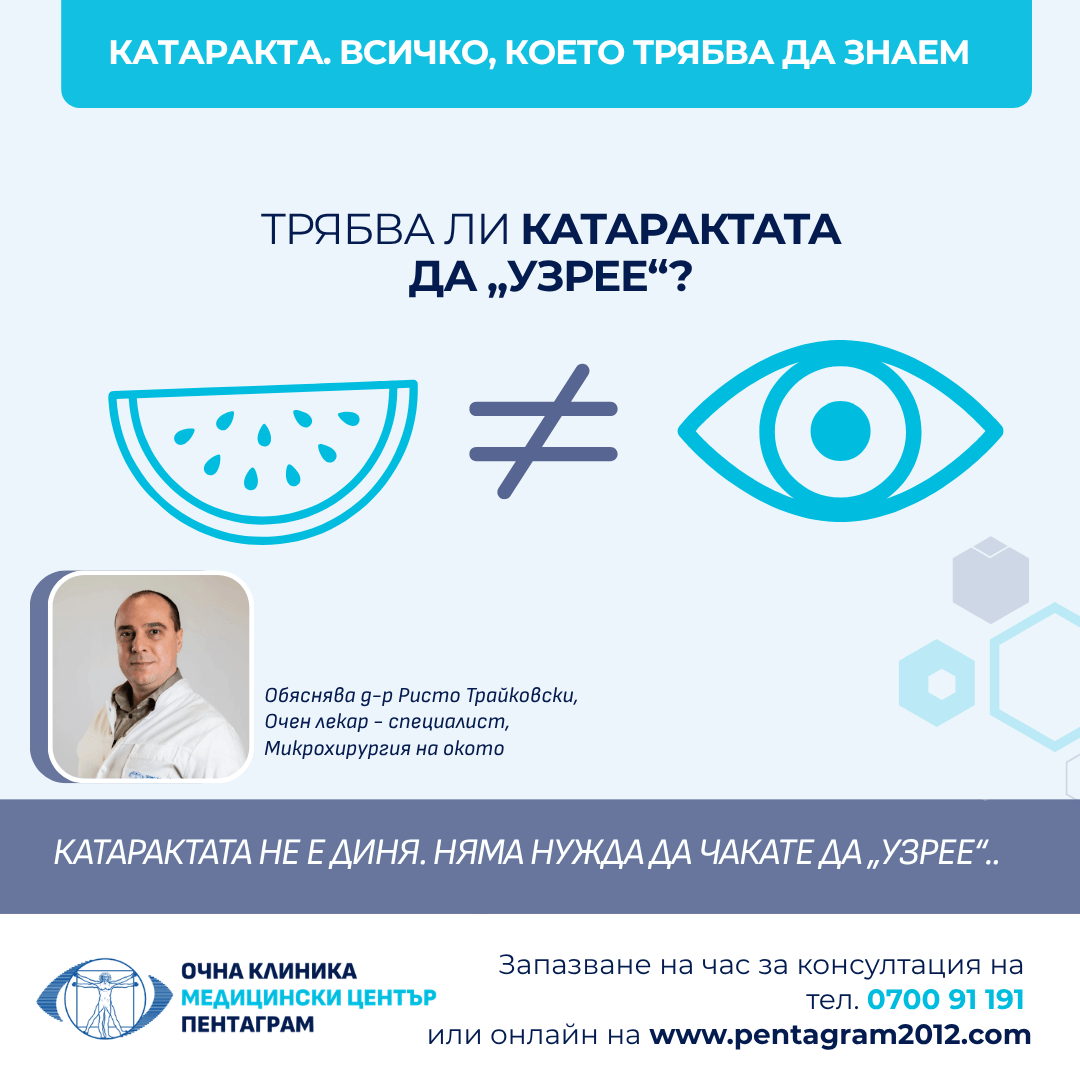
A Cataract Is Not a Watermelon: You Don’t Have to Wait for It to “Ripen”
You’ve been told you have a cataract—but life is busy, right? Between work, family, or just the general pace of things, it may be tempting to put surgery off for a while. Maybe your vision is “not that bad yet,” or you’re simply not ready to go under the knife. But here’s what matters: delaying cataract surgery isn’t always harmless. In fact, waiting too long can make surgery more complex, increase the chance of complications, and lead to less than ideal long-term results. Let’s look at why timely intervention matters—and what research shows about waiting too long.
Why People Delay Cataract Surgery
Let’s be honest. There are many reasons people delay cataract surgery. Sometimes it’s fear—fear of surgery, fear of anesthesia, or fear that something might go wrong. Other times it’s a matter of logistics—perhaps you’re on a waiting list or struggling to find time around work or caring for loved ones. Cost can also play a role when you’re considering treatment.
There’s also a misunderstanding about what a cataract actually causes. Because it often worsens slowly, people adapt. You might turn up the brightness on your phone, start using a magnifying glass, or avoid driving at night. Before you know it, you’re living with blurry vision, but you’ve come to see it as normal.
What many people don’t realize is that a cataract is more than just an inconvenience—it’s a progressive condition. And if you wait too long, surgery to remove it becomes more difficult. Much more difficult.
The Natural Progression of a Cataract
A cataract does not stay the same. Over time, proteins in the lens of your eye clump together and harden. At first, things may just seem a little cloudy, or you may be sensitive to light. But as you age, the cataract becomes denser and darker.
In advanced stages, a cataract can become what is called “mature.” This means that the lens is not only opaque but may begin to leak proteins, swell, and even cause inflammation in the surrounding tissues. These cases are not just more difficult to operate on—they carry a significantly greater risk.
What many people don’t realize is that waiting until things get “bad enough” may mean undergoing a more dangerous, technically complex procedure.
What the research tells us about surgical risk
The evidence is quite clear: the longer you wait, the greater the risks. This has been demonstrated in a number of clinical studies.
One of the key concerns is posterior capsule rupture (PCR) – when the delicate back wall of the lens capsule tears during surgery. This is more common with harder cataracts because the surgeon must apply more ultrasound energy (through phacoemulsification), increasing the likelihood of damage. PCR can lead to vitreous loss, dropped lens fragments, and the need for further surgery.
There is also an increased risk of corneal endothelial cell loss. These are the cells that keep your cornea clear and healthy. The denser the cataract, the more energy is needed to break it up – and the more collateral damage is done to these vital cells.
Then there is the issue of zonular weakness, especially with a hypermature cataract. Zonules are the tiny fibers that hold your lens in place. If the lens has swollen and shrunk over time, these zonules can weaken or break, making it much harder to securely implant an intraocular lens (IOL).
Dense cataracts and the challenges of phacoemulsification
Cataract surgery has come a long way, with phacoemulsification (a method in which the eye’s natural, clouded lens is broken up with ultrasound and replaced with an artificial intraocular lens) as the gold standard. But dense cataracts pose a real test of the surgeon’s skills and the machine’s capabilities. The ultrasound probe used to emulsify the lens must work much harder to break up the hard nucleus – and that comes with several caveats.
First, increased phaco energy generates more heat, which can damage the corneal incision site or cause localized burns. This, in turn, affects wound healing and can lead to postoperative complications.
Second, dense cataracts reduce the red reflex – the backlighting effect that surgeons use to visualize the lens capsule. When this reflex is weak, visibility is reduced, making delicate maneuvers more difficult.
Finally, hypermature cataracts can be intumescent (swollen with fluid), and capsulorhexis—the first crucial step, in which the anterior lens capsule is opened—becomes a high-stakes challenge. If the pressure inside the capsule is high, the capsule can tear uncontrollably, resulting in the so-called “Argentinian flag sign”—a dramatic and dangerous radial tear.
Visual outcomes may be worse if you wait too long
It is tempting to assume that once the cloudy lens is removed, everything will be fine. But that is not always the case. Several long-term studies show that delaying surgery—especially when vision is very poor to begin with—can reduce the likelihood of regaining optimal vision.
Why? First, your brain adapts to poor vision over time, and visual neuroplasticity may decline with age. This means that even after surgery clears your optical pathway, your brain may not fully adapt to the sudden clarity. You may never reach the visual potential you could have achieved with earlier intervention.
Also, with advanced cataracts, it is harder to obtain an accurate preoperative measurement of the eye. Biometry—the process of calculating the correct power for your intraocular lens—depends on light passing clearly through the eye. Dense cataracts interfere with this, which can lead to less accurate refractive outcomes.
There is also a risk of associated eye conditions. Delayed cataract treatment is associated with secondary problems such as angle-closure glaucoma or lens-induced uveitis, both of which can cause permanent vision damage even after the cataract is removed.
Psychological and lifestyle effects of waiting
Cataracts affect quality of life in surprising ways. People report reduced confidence, increased isolation, and a higher risk of depression as their vision deteriorates.
Older adults are especially vulnerable. Reduced visual acuity increases the risk of falls, fractures, and loss of independence. Driving becomes dangerous. Reading becomes a chore. And in some cases, people stop pursuing hobbies they once loved—all because of preventable and treatable cataracts.
It is easy to assume that you will “just manage” for a little longer. But the psychological burden of deteriorating vision often creeps up gradually—until it becomes overwhelming.
Are there ever good reasons to delay?
Yes, of course. Not every cataract needs immediate surgery. If your vision is functional, stable, and does not interfere with daily life, it is perfectly reasonable to postpone surgery. After all, surgery is a personal choice.
Also, some medical conditions may require waiting. If you have uncontrolled diabetes, active infections, or serious heart problems, it is wise to get them under control first. Your ophthalmologist will assess the risks and help you decide when the right time is.
But communication is key. Do not make the decision to delay on your own – and do not neglect your follow-up appointments. What seems manageable now can change quickly, and your surgeon is your best ally in getting the timing right.
How do surgeons handle late-stage cataracts?
When surgery becomes more complex, the surgical team adapts. In cases of dense cataracts, the surgeon may:
Use lower phaco energy with modified techniques such as “phaco chop” or “divide and conquer” to reduce collateral damage.
Use femtosecond laser-assisted cataract surgery (FLACS) to create precise incisions and soften the lens.
Use larger amounts of viscoelastic materials to protect the corneal endothelium.
Use capsular tension rings if zonular weakness is detected.
Prepare for a possible vitrectomy (microsurgery to remove the vitreous, the clear gel-like substance inside the eye) if lens fragments fall into the vitreous.
These steps help ensure safety, but they require more time, skill, and sometimes additional equipment. And while many of these surgeries are still successful, they are more complex than surgeries performed at an earlier stage.
How long is too long?
There is no universal cutoff date after which surgery is considered too late. However, most ophthalmologists agree that once a cataract interferes with daily activities – especially reading, driving, or recognizing faces – it is time to act.
Clinically, if your visual acuity drops below 0,5 (20/40) or your lens density is graded 3 or higher on the LOCS III scale, you are likely approaching the threshold at which surgery becomes more complex.
Complications such as pseudoexfoliation, phacodonesis (wobbling of the lens), or signs of lens-induced glaucoma are red flags – they indicate that waiting any longer could permanently compromise your vision.
The case for early intervention
The best outcomes are achieved when surgery is performed before the cataract becomes too advanced. Why? Because:
-Surgery is easier, faster, and safer.
-Visual recovery is usually faster.
-The likelihood of needing additional surgery decreases.
-You have the best chance of precise refractive correction.
-Your overall quality of life improves sooner rather than later.
Early surgery does not mean rushing into it as soon as you are diagnosed. It simply means not waiting until your vision has deteriorated to a dangerous level. It is about the right timing – and this decision should always be made with your ophthalmologist.
Frequently Asked Questions (FAQ)
Is it too late for cataract surgery?
- Usually not – but the longer you wait, the more difficult it becomes. Cataract surgery can still be performed in advanced stages, but it is riskier and more complex. The lens may become so hard or swollen that standard techniques must be modified. There is also a greater risk of complications such as posterior capsule rupture, zonular instability, and corneal damage. So, while there is rarely a point at which surgery is completely ruled out, earlier intervention often means better outcomes and fewer surprises in the operating room.
What are the signs that I have waited too long for cataract surgery?
- Several red flags suggest that you may have waited longer than ideal. If your vision has declined to the point where you struggle to read, recognize faces, or drive safely – especially at night – that is a clear signal. In some cases, you may experience glare, double vision in one eye, or even signs of pressure buildup, such as eye pain or redness. These could point to complications such as glaucoma or lens-induced uveitis, and you should see an ophthalmologist urgently. When my daily life is constantly disrupted by vision problems, it is time to act.
Will I regain my vision if I have cataract surgery at a late stage?
- In many cases, yes – but with some caveats. Although surgery can still significantly improve your vision, the results may not be as clear or predictable as they would have been if the surgery had been performed earlier. A late-stage cataract can interfere with accurate lens measurements before surgery, which may lead to suboptimal refractive outcomes. Also, long-term visual deprivation can reduce your brain’s ability to adapt to the new clarity. Nevertheless, many patients still achieve significant improvements in vision, especially when the rest of the eye is healthy.
Are complications more likely with a dense or mature cataract?
- Absolutely. A mature or hypermature cataract requires more ultrasound energy to break up the lens, increasing the risk of damage to surrounding structures in the eye. There is a greater chance of tearing the lens capsule, which can lead to complications such as vitreous loss or the need for a second surgery. The cornea is also more vulnerable because of the longer surgery time and trauma. Surgeons may need to take additional precautions, use specialized instruments, or change their approach—all of which make the procedure more complicated.
What is a hypermature cataract, and why is it a problem?
- A hypermature cataract is an advanced form of lens clouding in which the lens has become both hard and unstable. It often leaks proteins, causing inflammation, or shrinks in a way that weakens the structures holding it in place. These changes can cause secondary conditions such as lens-induced glaucoma or make the cataract extremely difficult to remove. Surgery in such cases carries a greater risk, especially if zonular support is compromised. This condition is best avoided by intervening before the cataract reaches this stage.
How do surgeons manage complex cataract surgeries caused by delays?
- Experienced surgeons adapt their techniques based on the condition of the eye. For denser cataracts, they may use lower-energy phacoemulsification strategies or soften the lens with a laser beforehand. They will also use protective substances to shield the cornea and take extra care when opening the lens capsule. If the supporting structures are weak, they may implant devices such as capsular tension rings or even use alternative locations for lens placement. Although these strategies help, they also lengthen the procedure and recovery time—another reason why earlier surgery is generally preferred.
Can delaying cataract surgery affect my chances of getting a premium intraocular lens (IOL)?
- Yes, it can. Premium intraocular lenses—such as multifocal, toric, or extended depth-of-focus lenses—require very precise eye measurements and a stable eye environment. A dense cataract can interfere with accurate biometry, and zonular instability can make placement of these lenses unsafe. If your cataract is too advanced, your surgeon may recommend sticking with a standard monofocal IOL to ensure stability and reduce risk. So, if you are considering premium lenses, earlier surgery helps keep all your options open.
How long can I realistically wait before cataract surgery becomes risky?
- There is no exact deadline, but most surgeons recommend not waiting once your visual acuity falls below 0.5 or your daily tasks become increasingly difficult. A good rule of thumb? If you have noticed a steady decline in your vision and it is affecting your quality of life, it is better not to wait. Clinical signs such as lens density, intraocular pressure, or lens swelling are also factors. Regular follow-up appointments will help your ophthalmologist assess when the risks and benefits favor surgery.
Can delaying surgery cause permanent vision damage?
- In some cases, yes. If the cataract leads to complications such as angle-closure glaucoma, chronic inflammation, etc.
Final thoughts
Cataracts are common, but they are not benign. They are a progressive condition with real consequences when left untreated for too long. Delaying surgery may seem like a reasonable choice at first – perhaps you are not “quite ready” or you feel things are not “bad enough.” But when the risk of complications rises, surgery becomes more difficult, and long-term outcomes are compromised, you may find yourself wishing you had acted sooner.
The good news? Cataract surgery is one of the safest and most effective procedures in modern medicine. But to get the best results, timing is everything. So, if you are hesitating – talk to your surgeon, get your eyes examined, and take the next step while you still have the luxury of choice.
***
Dr. Risto Trajkovski is one of the experienced ophthalmologists at Pentagram Eye Hospital (12 + years of experience as a specialist and 4 as a resident). He was born in the Republic of North Macedonia but completed his higher education in Bulgaria. Almost his entire career has been tied to Bulgaria and to Dr. Veselin Daskalov, his professional mentor. Dr. Trajkovski’s clinical interests include diseases of the anterior and posterior segments of the eye. In his free time, he enjoys skiing and mountain hiking and relaxes with good music.
You can make an appointment for a consultation with him by calling 0700 91 191 or online. Appointments are available with an NHIF referral, through a health insurance fund, or on a self-pay basis.

Strong participation by Pentagram Eye Hospital in the European Congress of Cataract and Refractive Surgery (ESCRS)
Once again this year, the Pentagram Eye Hospital team, led by Dr. Veselin Daskalov, actively participated in the most significant.
Read More
How to Choose Sunglasses
Sunglasses are more than a fashion accessory – they are important tools for protecting your eyes from ultraviolet (UV) rays.
Read More