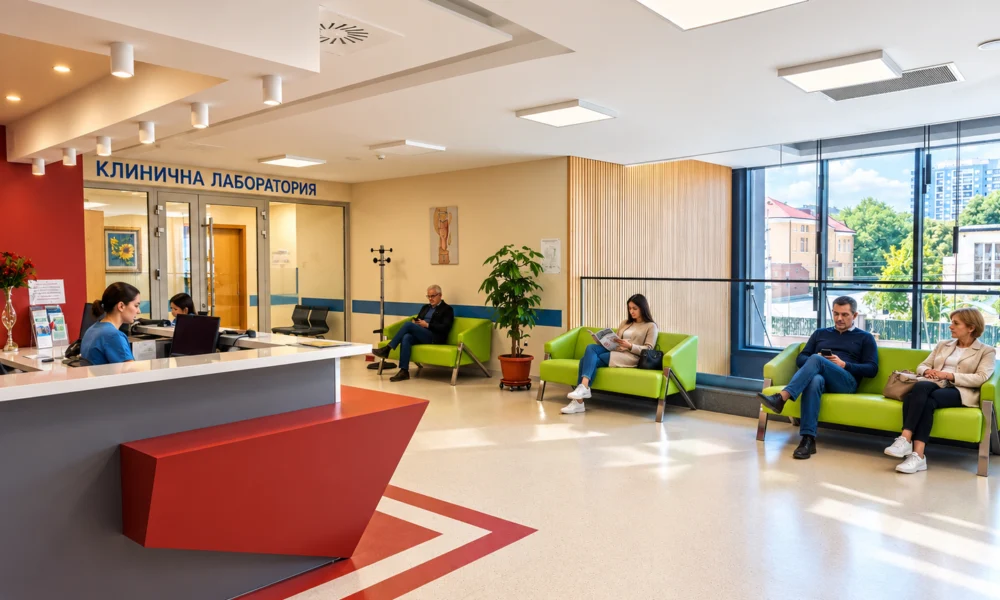
General Information and Key Steps
Pentagram Eye Hospital and Medical Center is a modern healthcare facility in Sofia specializing in the diagnosis and treatment of eye diseases, with extensive clinical experience and the ability to provide modern invasive and noninvasive treatments.
In addition to highly specialized ophthalmic care, Pentagram Medical Center offers qualified medical services in the following specialties:
- Obstetrics and Gynecology
- Cardiology
- Endocrinology
- Neurology
- Ear-Nose-Throat (ENT)
First Visit
- Make an appointment by phone (0700 91 191, 02 447 2040, 02 447 2050) or online through the clinic's website.
- Arrive at the clinic at least 10 minutes before the time specified by your treating physician and notify the medical secretaries at the registration desk.
- Register as a patient - the date and time of your visit are already recorded in the hospital information system.
- Present an identity document; the clinic is a personal data controller under the Personal Data Protection Act.
- Receive comprehensive information about the procedures for examinations, consultations, and interventions; you can ask questions on site at any time.
- Bring all available medical records from previous treatment (discharge summaries, test results, and examination reports)
Outpatient Care
Outpatient care is provided at Pentagram Medical Center. It includes outpatient examinations, consultations, diagnostic tests, and procedures that do not require a stay at the clinic (e.g., a standard eye exam, laboratory tests, ultrasound, ECG, etc.).
Inpatient Care
Inpatient care is provided at Pentagram Eye Hospital for patients admitted for surgery or treatment requiring a stay at the hospital. It may be provided under an NHIF clinical pathway or as a paid service.
Hospital Stay
Contacts Us
0700 91 191
Hospital Admission
Admission for planned hospitalization takes place after a consultation with the treating physician, who determines the admission date and the required documents (referral, ID card, health insurance booklet/status, and preoperative test results). Admission follows a prearranged process upon presentation of Referral No. 7 for hospitalization. Documents are received and processed in offices 108 and 109. The following tests and documents are required for hospitalization.- Patient's ID card
- Laboratory test results
- ECG + outpatient record with an opinion on surgical treatment
- Referral No. 7 for hospitalization
- Outpatient record of an examination by an ophthalmologist.

Hospital Meals
Meals are not provided for same-day surgery because the stay at the medical facility is short and the patient is discharged on the day of the procedure. In preparation for surgery, you may be instructed to limit your intake of food and/or fluids. Please follow the instructions given by your treating physician or anesthesiologist strictly. If you have special dietary needs or medical conditions that require a specific diet, please inform the medical team in advance.
Hospital Routine
During their stay at the clinic, patients must follow the instructions of the medical staff and the established facility rules.Please:
- Arrive at your scheduled admission time with the required documents and test results.
- Follow your treating physician’s instructions regarding preparation for surgery and postoperative care. < br> - Do not leave the clinic without the medical team’s knowledge and permission. < br> - Use the protective equipment provided when necessary and follow hygiene rules.
- Inform the medical staff immediately if you experience pain, a sudden deterioration in vision, bleeding, or any other unexpected symptom.
Visiting and Patient Information
Visitors are not permitted for same-day surgery because patients stay at the medical facility for only a short time. People accompanying patients may wait in the clinic’s designated areas. When necessary, information about the patient’s condition is provided to a person designated by the patient, in accordance with personal data protection and medical confidentiality requirements. Information is provided:- in person to the individual designated by the patient;
- by phone, when possible and after the caller’s identity has been verified in accordance with the medical facility’s established procedures.
After the procedure and before discharge, the treating physician or a member of the medical team informs the patient about the outcome of treatment, recommendations for home care, and the date of the follow-up examination. With the patient’s consent, the same information may also be provided to a person accompanying them.
Accompanying Person
Accommodations for accompanying persons are not provided for same-day surgery because patients do not stay overnight at the hospital. If necessary, the patient may be accompanied to the admissions unit and met upon discharge. Companions wait in designated areas of the facility. For children and patients who need constant assistance due to their health condition, a companion is permitted in accordance with procedures established by the facility and the clinic’s operating arrangements.Coverage of Treatment Costs
Pentagram Eye Hospital and Medical Center have contracts with the National Health Insurance Fund (NHIF) to provide inpatient and outpatient care, as well as highly specialized medical services. The clinic offers several payment options tailored to patients’ needs:
• Payment through the National Health Insurance Fund (NHIF).
• Acceptance of referrals from a primary care physician (specialist referral, referral for highly specialized services, etc.).
• Cooperation with private health insurance funds and corporate programs.
• Self-pay appointments, with an invoice available upon request.
• Payment by cash or bank card at the reception desk.
Some services may not be fully covered by the NHIF. The clinic’s team provides precise information about coverage and required documents before the examination or procedure.
Patients with Health Insurance
Patients with continuous health insurance coverage may receive medical care funded by the National Health Insurance Fund (NHIF), subject to the conditions and procedures established by current regulations and the National Framework Agreement.

Outpatient Medical Care
To receive specialized outpatient medical care, you must have:
• valid health insurance coverage;
• a referral for a consultation or test issued by a primary care physician or specialist, when required;
• an identity document;
• medical records relevant to the specific disease or condition, if available.
Depending on the type of service, examinations, diagnostic tests, consultations, and other medical services covered by the National Health Insurance Fund (NHIF) may be provided in accordance with current rules.
Hospital Medical Care
If hospitalization is required under a clinical pathway, outpatient procedure, or clinical procedure, the patient must present:
• an identity document;
• a referral for hospitalization, where applicable;
• medical documents confirming the condition and the need for treatment (discharge summaries, test results, diagnostic imaging, etc.);
• other documents required under applicable regulations and the medical facility’s internal rules.
Upon admission to the medical facility, the patient’s health insurance status and compliance with the medical criteria for the relevant clinical pathway or procedure are verified. When all legal requirements are met, treatment is provided under NHIF funding terms.
Note: Specific requirements for required documents, preliminary tests, or admission criteria may apply to certain medical services or clinical pathways. These are determined in accordance with applicable regulations and the National Framework Agreement.
Patients Paying for Their Own Treatment
Patients without health insurance coverage, foreign nationals outside the scope of European coordination, or patients who choose a service not covered by the NHIF pay in cash or by bank card and receive an invoice upon request.
Patients with supplemental health insurance
The clinic works with private health insurance funds. Patients with supplemental health insurance are served according to each fund's individual plan, either through direct payment or reimbursement by the insurer.
Contracts with insurance funds
Pentagram Eye Hospital and Medical Center have contracts with the following health insurance funds:
– Groupama Insurance, BULSTRAD VIENNA INSURANCE GROUP, Saglasie Insurance Company, Bulgaria Insurance, LEV INS, Axiom Insurance, Generali Insurance, Allianz Bulgaria Insurance
Clinical pathways
The clinic provides care under the following National Health Insurance Fund ophthalmology clinical pathways:
Outpatient Procedure No. 19 "Surgical removal of cataracts"
Outpatient Procedure No. 20 "Surgical treatment of glaucoma" – for patients older than 28 days
Outpatient Procedure No. 21 "Surgical procedures on the eye and its adnexa of moderate extent and complexity" – for patients older than 28 days
Outpatient Procedure No. 38.1 "Provision of high-cost medications under Article 78, item 2 of the Health Insurance Act"
Clinical Pathway No. 130 "Surgical procedures on the ocular adnexa of major extent and complexity"
Clinical Pathway No. 131 "Other operations on the eyeball of major extent and complexity"
Clinical Pathway No. 132 "Keratoplasty"
Clinical Pathway No. 133 "Conservative treatment of glaucoma, vascular diseases of the eye, and nonpenetrating injuries"
Clinical Pathway No. 134 "Conservative treatment of infections and inflammatory diseases of the eye and its adnexa"
Clinical Pathway No. 135 "Surgical treatment of diseases of the retina and vitreous and injuries affecting a segment of the eye"
Pentagram
Eye Hospital
Medical tourism
Citizens of EU member states, the European Economic Area, and Switzerland can receive medical care at the clinic through one of the following two arrangements:
- Under Regulations (EC) No. 883/2004 and No. 987/2009 on the coordination of social security systems — with an S2 form (formerly E112) issued in advance. In this case, payment for treatment is made directly between the health insurance institutions, and the patient incurs no cost for the treatment itself.
- Under Directive 2011/24/EU on the application of patients’ rights in cross-border healthcare — in this case, no S2 form is issued; the patient pays for treatment at the clinic’s rates and may then request reimbursement from their health insurance institution under the terms of Ordinance No. 5 of March 21, 2014. Prior authorization under this procedure is required only for expressly specified services.
What you need to provide
For treatment under the Regulations (with an S2 form):
- Valid identification (ID card or passport).
- An S2 form issued by the patient's competent health insurance institution.
- Medical records from previous treatment (discharge summaries, test results), translated if possible.
For treatment under Directive 2011/24/EU (without an S2 form):
- Valid identification (ID card or passport).
- Medical records from previous treatment, translated if possible.
- For services requiring prior authorization under Ordinance No. 5/2014 - the relevant approval document from the patient's health insurance institution.
Price List
Find the current price list for services at Pentagram Eye Hospital and Medical Center by clicking the button.
Contacts Us
0700 91 191General information
Have questions? Enter your search below.
A comprehensive eye exam includes an assessment of vision and eye structures to diagnose potential eye diseases. This is a fundamental part of eye health care and is recommended for people of all ages. The examination is performed by an ophthalmologist and typically includes:
-
measuring visual acuity and determining refraction
-
measuring intraocular pressure (tonometry) — an important indicator of glaucoma risk
-
examining the anterior segment of the eye, cornea, and lens
-
examining the fundus and retina (with a dilated pupil)
- prescribing optical correction if needed
Regular preventive eye exams can detect serious conditions such as glaucoma, macular degeneration, cataracts, diabetic retinopathy, and others at an early stage, when treatment is more effective. Specialists recommend an annual eye check-up for adults and at least twice during childhood development – before starting school and in the early school years.
At our hospital, we have the full range of equipment to help us with diagnosis. Vision is everything. Take care of it in time – a preventive exam can prevent its loss.
In today's digital world, taking care of your eyes is more important than ever. Prolonged use of a computer, phone, or tablet can lead to fatigue, dryness, blurred vision, and even headaches. Fortunately, with a few simple habits, you can effectively take care of your vision in daily life.
1. Wear proper optical correction (if prescribed). Incorrectly chosen glasses or lenses can strain your vision. Regularly visit an eye specialist for check-ups and updates to your prescription.
2. Ensure proper lighting. Work in a well-lit area, avoiding direct light into your eyes or strong contrast between the screen and the environment. Use screen filters or 'warm light' settings, especially in the evening.
3. Follow the 20/20/20 rule. One of the simplest and most effective rules for visual hygiene: Every 20 minutes, look at an object 20 feet away for at least 20 seconds. This gives your eye muscles a break and reduces strain from screen use.
4. Blink often. When staring at a screen, we blink less often, which leads to eye dryness. Remind yourself to blink regularly, especially if you feel dryness or burning, and use artificial tears.
5. Wear sunglasses UV rays can harm your eyes even on cloudy days. Wear glasses with UV protection when outdoors. Eye care doesn't take much time but provides long-term benefits. Incorporate these tips into your daily routine and ensure long-term protection and comfort for your vision.
For children, the first examination is recommended around the age of three, followed by subsequent exams as needed or upon the recommendation of a specialist. Adults up to the age of 40 can have preventive check-ups every two years if they have no complaints. After the age of 40, an annual check-up is recommended, especially in cases of a family history of glaucoma and macular degeneration.
- A detailed examination is conducted to assess whether you are a suitable candidate for laser correction.
- Expectations, risks, and possible outcomes are discussed.
- Specialized tests are assigned, along with a comprehensive eye examination, such as keratotopography and Wavefront analysis – maps of corneal curvatures and spherical aberrations, pachymetry – determining the thickness of the cornea.
- Additional tests may also be conducted if necessary.
- BHS (early, at 11-13 weeks): This is a statistical method. Two hormones in the mother's blood are measured and combined with ultrasound data from the fetal morphology (nuchal translucency). The result is a probability (e.g., 1:5000). It does not provide a definitive diagnosis.
- DNA test (NIPT): This is a high-tech test where the baby's DNA is isolated from the mother's blood. Its accuracy for Down syndrome is over 99%, and it can determine the baby's sex as early as the 10th week. It is more expensive but much more reliable than BHS.
- AMH (Anti-Müllerian Hormone): A blood test that can be done on any day of the cycle. Low levels suggest that the number of eggs is decreasing.
- Antral follicles: Counted via ultrasound at the beginning of the menstrual cycle. This is important for women who are postponing motherhood, to know whether they have time or need to take measures (e.g., egg freezing).
The preventive examination includes:
- Consultation and medical history taking
- Examination with a gynecological speculum
- Cytology (Pap test) for early detection of cancerous and precancerous changes
- Colposcopy
- Ultrasound examination (sonography) of the pelvis
- Infection screening and other assessments if necessary
Why is it important?
✔ Detection of diseases at an early stage ✔ Monitoring of reproductive health ✔ Planning pregnancy or contraception ✔ Peace of mind and confidence every month of the year Don't postpone taking care of yourself – a preventive gynecological examination takes minutes but can save you years of worry. Schedule an appointment with our specialists today!- A detailed examination is conducted to assess whether you are a suitable candidate for laser correction.
- Expectations, risks, and possible outcomes are discussed.
- Specialized tests are assigned, along with a comprehensive eye examination, such as keratotopography and Wavefront analysis – maps of corneal curvatures and spherical aberrations, pachymetry – determining the thickness of the cornea.
- Additional tests may also be conducted if necessary.
- Hematological diagnostics
- Coagulation diagnostics
- Biochemical diagnostics
- Monitoring the electrolyte balance in the body
- Immunohematology
- Hormonal diagnostics
- Tumor markers
- Infectious serology, virology, parasitology, microbiology
Thyroid problems can affect various functions of the body and often go unnoticed in the early stages. The most common symptoms of impaired thyroid function include:
-
unexplained weight gain or loss
-
constant fatigue and drowsiness
-
irritability or mood changes
-
dry skin and hair loss
-
changes in heart rate (rapid or slowed pulse)
-
menstrual cycle disorders
These symptoms may be associated with either hypothyroidism (reduced activity) or hyperthyroidism (increased activity) of the thyroid gland. If you experience such complaints, it is advisable to consult an endocrinologist.
Heart diseases are among the leading causes of mortality worldwide and often develop slowly, with unnoticeable symptoms. Recognizing them in time is crucial for prevention and treatment.
The most common symptoms of heart diseases include:
-
chest pain or tightness (angina pectoris)
-
shortness of breath, especially during physical exertion or while lying down
-
a sensation of skipped or rapid heartbeat (palpitations)
-
easy fatigue and lack of energy
-
dizziness or fainting
-
swelling of the legs and ankles (edema), especially at the end of the day
It is important to note that in women, elderly individuals, and people with diabetes, the signs may be atypical – such as fatigue, nausea, or discomfort in the back or neck, without chest pain.
If one or more of these symptoms are present, it is advisable to consult a cardiologist and undergo basic examinations.
Early detection of heart problems significantly increases the chances of successful treatment and a fulfilling life. Do not delay checking your heart health.
