

Intraocular lenses for cataract surgery: types, selection, and what to expect

What is an intraocular lens
An intraocular lens (IOL) is an artificial implant that replaces the eye’s natural lens during cataract surgery and restores clear vision. There are several main types of IOLs – monofocal, toric, multifocal, EDOF, and enhanced monofocal – each providing a different range of vision and degree of independence from glasses. Choosing the right lens depends on the condition of the eye, the patient’s lifestyle, occupation, and vision goals. After surgery, vision gradually becomes clearer, and expectations should be aligned with the chosen lens and the individual characteristics of the eye.
A cataract is a clouding of the eye’s natural lens – the transparent structure that allows light to pass through and focuses it on the retina. With age, the lens gradually loses its transparency, which can lead to blurred vision, glare, increased sensitivity to light, and difficulty reading or driving at night.
When a cataract begins to significantly interfere with daily life, the main effective treatment is surgery. During the procedure, the clouded natural lens is removed and replaced with an artificial intraocular lens (IOL). It remains in the eye and takes over the natural lens’s function of focusing light on the retina.
Choosing an intraocular lens is an important part of preparing for surgery. It can affect distance, intermediate, and near vision, as well as the likelihood that you will need glasses after surgery.
It is important to know: there is no single “best” intraocular lens suitable for all patients. The right choice depends on the condition of the eyes, lifestyle, visual needs, and expectations of the individual.
What is an intraocular lens?
An intraocular lens is a small optical device that replaces the natural lens after it is removed during cataract surgery.
Most modern IOLs are made of biocompatible acrylic materials. Both hydrophobic and hydrophilic acrylic lenses are available.
The lens is usually placed in the natural capsular bag, where the natural lens was located. There it stabilizes and performs its optical function.
What determines the characteristics of an IOL?
Key characteristics include:
· Optical power – measured in diopters and calculated individually for each eye.
· Optical design – determines whether the lens provides primarily one focal point or a wider range of vision.
· Material – affects the mechanical and optical characteristics of the lens.
· Shape and size – including the diameter of the optic and the design of the haptics, which stabilize the lens.
What types of intraocular lenses are used?
Broadly speaking, IOLs can be divided according to their visual goal and optical design into monofocal, toric, multifocal, EDOF, and modern enhanced monofocal designs.
It is important to know that these categories can be combined. For example, there are toric monofocal, toric EDOF, and toric multifocal lenses.
1. Monofocal intraocular lenses
The monofocal lens is the traditional and widely used option. It is designed to provide clear vision primarily at one chosen distance – most often far away.
When distance focus is chosen, the patient usually needs glasses for reading and other close-up activities.
Advantages
· good and predictable vision at the chosen distance;
· good contrast;
· usually fewer unwanted optical phenomena compared with multifocal lenses;
· a suitable choice for many patients, including those with other eye conditions.
Disadvantage
The main disadvantage is that glasses are usually still needed for activities at other distances.
However, a monofocal lens should not be considered an “inferior” lens. For many patients, it is the most sensible choice when vision quality, contrast, and minimizing optical phenomena are priorities.
2. Toric intraocular lenses
Toric lenses are designed for patients with corneal astigmatism.
In astigmatism, the cornea is not perfectly spherical, which can cause blurred or distorted vision. A toric IOL has a special optical design that allows it to compensate for a certain amount of this astigmatism.
A toric lens can be:
· monofocal;
· enhanced monofocal;
· EDOF;
· multifocal.
In suitable patients, toric lenses can significantly reduce residual astigmatism after surgery. European guidelines consider toric IOLs an option for regular corneal astigmatism, with the benefit increasing as the amount of astigmatism increases.
Why is the position of a toric lens important?
A toric IOL must be placed on the correct axis. If it rotates from the planned position, the effect of the astigmatism correction may decrease.
That is why preoperative measurements and planning are especially important. When planning for a toric IOL, corneal topography or tomography is also recommended several days before surgery to allow enough time for delivery of the required IOL.
3. Multifocal intraocular lenses
Multifocal lenses are designed to provide vision at more than one distance.
In suitable patients, they can reduce dependence on glasses for:
· distance vision;
· intermediate vision;
· near vision.
This makes them appealing to people who want greater independence from glasses in everyday life.
But this broader vision goal involves certain trade-offs.
Possible optical phenomena
With multifocal lenses, the following may occur:
· halos around light sources;
· glare;
· starbursts around bright lights;
· changes in contrast sensitivity.
These phenomena are related to how the optical design distributes light among different viewing distances. Many patients adapt over time, and the phenomena become less noticeable, but there is no guarantee that they will disappear completely. ESCRS (the largest organization for cataract and refractive surgery) notes that unwanted optical phenomena are more common with multifocal lenses than with monofocal lenses.
Therefore, a multifocal lens should not be chosen solely with the goal of eliminating the need for glasses. It is necessary to assess whether the individual patient accepts the possible trade-offs.
4. EDOF lenses – extended depth of focus
EDOF stands for Extended Depth of Focus.
These lenses are designed to provide a wider range of functional vision, especially at distance and intermediate ranges.
They may be an appealing option for patients who:
· want more freedom from glasses;
· work on a computer;
· need good intermediate vision;
· do not want or are not suitable candidates for a conventional multifocal lens.
With many EDOF designs, near vision is more limited than with multifocal lenses, and glasses may be needed for small print.
European guidelines consider EDOF/EDF lenses an option for patients who want good intermediate vision, with fewer dysphotopsias (visual disturbances) than with multifocal lenses.
5. Enhanced monofocal lenses
Modern intraocular lenses also include designs that can be considered an intermediate option between a standard monofocal lens and lenses for presbyopia correction.
They retain the basic concept of a monofocal lens but are designed to extend the functional range of vision.
For some patients, this may mean better intermediate vision, for example when working on a computer, without necessarily aiming for complete independence from reading glasses.
The exact effect depends on the specific optical design and the individual characteristics of the eye.
How is the right intraocular lens chosen?
An IOL should not be chosen based solely on price, brand, or which technology is the “newest.”
The decision should be made jointly by the patient and the ophthalmologist, taking into account both medical factors and personal preferences. This is consistent with current ESCRS recommendations for an individualized choice of lens and visual target.
Factors to consider
– Lifestyle
A person who drives frequently, plays sports, works on a computer, and reads daily may have different priorities from someone who spends most of their time at home.
– Occupation
Computer work places greater importance on intermediate vision. Priorities may differ for occupations that require highly precise vision.
– Night driving
For people who frequently drive at night, possible halos, glare, and other optical phenomena should be carefully discussed.
– Reading needs
It is important to determine how often the patient reads and whether they read regular text or very small print.
– Astigmatism
The presence and degree of corneal astigmatism may point toward choosing a toric IOL.
– Corneal condition
Corneal irregularities, dry eye, or other ocular surface problems can affect the quality of vision after surgery.
– Macula and retina
Diseases of the macula or retina can limit the expected visual outcome and influence the choice of lens.
– Glaucoma and other eye diseases
The presence of coexisting conditions must be considered when choosing an optical design.
– Previous laser vision correction
In patients who have undergone previous corneal refractive surgery, calculating the required optical power of the IOL can be more complex.
– Expectations
This is one of the most important factors. The optimal choice for a patient who is willing to use reading glasses may be very different from that for a patient whose main priority is independence from glasses.
What tests are done before choosing an IOL?
Choosing a lens begins with a comprehensive eye exam and measurements.
One of the key tests is biometry, which measures the parameters of the eye needed to calculate the appropriate optical power of the implant.
Depending on the individual patient, the following may also be needed:
· corneal measurements;
· keratometry;
· corneal topography or tomography; (at the treating physician’s discretion)
· evaluation of the ocular surface and dry eye;
· examination of the macula and retina;
· OCT of the posterior segment of the eye when indicated; (at the treating physician’s discretion)
· evaluation of pupil characteristics;
· additional measurements following previous refractive surgery
· When planning an IOL for presbyopia correction, ESCRS recommends careful patient selection and, when necessary, additional evaluation of dry eye, the cornea, the retina, and other factors.
How is cataract surgery performed?
Cataract surgery is usually performed under local anesthesia (eye drops) when appropriate for the patient.
During the procedure, the surgeon:
1. makes a small surgical incision;
2. removes the clouded natural lens;
3. implants the selected intraocular lens;
4. leaves the IOL stabilized in the eye.
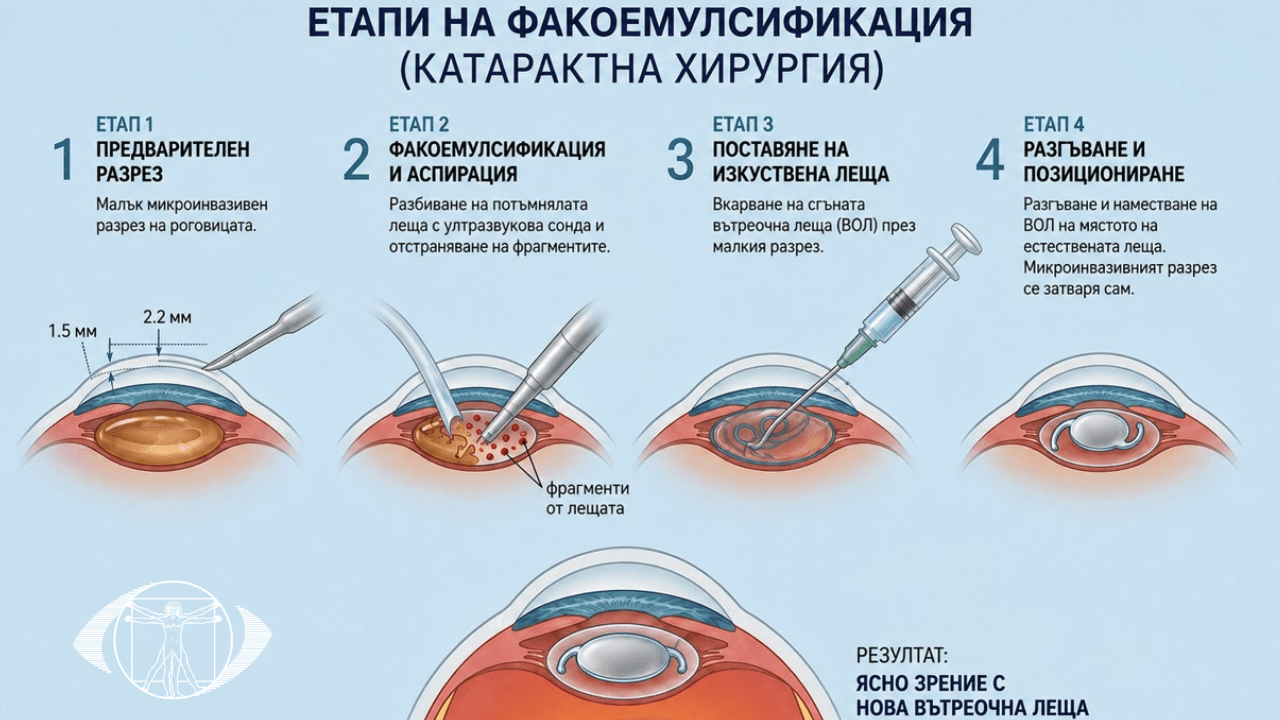
Modern cataract surgery is usually brief and performed on an outpatient basis, but the specifics depend on the condition of the eye and the surgical technique.
There are both standard techniques for cataract surgery and femtosecond laser-assisted surgery. According to ESCRS recommendations, both approaches can be safe and effective in suitable patients.
What can you expect after surgery?
After surgery, vision gradually becomes clearer. Initially, you may experience:
· mild blurring;
· sensitivity to light;
· a foreign body sensation;
· dryness or discomfort;
· temporary glare or visual phenomena.
Postoperative eye drops are usually prescribed, and follow-up examinations are performed at the ophthalmologist’s discretion.
It is important for the patient to follow the instructions provided and seek medical attention in the event of a sudden worsening of vision, severe pain, pronounced redness, or other concerning symptoms.
What are the risks of surgery?
Cataract surgery has a strong safety profile. It is also the most commonly performed procedure worldwide. Like any surgical procedure, it is not entirely without risks.
Possible complications can occur during surgery or in the early or late postoperative period. These include:
· problems with lens stability;
· inflammation;
· increased intraocular pressure;
· infection inside the eye;
· corneal swelling;
· retinal detachment;
· residual refractive error;
· unwanted optical phenomena.
Serious complications are relatively rare, but individual risk depends on the condition of the eye and the patient’s overall health and individual characteristics.
Will I be free from glasses after surgery?
This is one of the most common questions.
The answer depends on the IOL selected and the planned visual goal.
With a standard monofocal lens set for distance vision, reading glasses are usually needed.
Multifocal lenses are designed to reduce dependence on glasses for distance, intermediate, and near vision in suitable patients.
EDOF and enhanced monofocal designs can provide greater freedom from glasses for intermediate activities, but glasses may still be needed for small print.
No lens can guarantee that a particular patient will never need glasses.
What happens if a refractive error remains after surgery?
Even with very precise preoperative measurements, absolute accuracy to the last hundredth of a diopter cannot be guaranteed.
A small residual refractive error may remain. Depending on its magnitude, its cause, and the patient’s needs, glasses or other methods of optimizing the visual outcome may be considered.
For this reason, it is more accurate to speak of a planned visual goal rather than a guarantee of a specific refractive result.
Which lenses are not suitable for every patient?
Multifocal, EDOF, and other extended-range-of-vision lenses require careful patient selection.
Extra caution may be needed in patients with:
· macular diseases;
· certain types and stages of glaucoma;
· corneal diseases;
· significant dry eye;
· irregular astigmatism;
· other conditions that can limit the quality of vision.
This does not mean that a particular lens is absolutely contraindicated in every case of these conditions. The final decision is made on an individual basis after an examination and an assessment of the expected benefits and possible trade-offs.
What does “premium intraocular lens” mean?
“Premium” is a term often used for lenses with additional visual goals, such as reducing dependence on glasses or correcting astigmatism.
This does not automatically mean that a premium lens is “better” than a standard monofocal lens.
A more complex optical design can provide more visual options, but it may also involve certain trade-offs, such as greater sensitivity to visual phenomena or more demanding requirements for preoperative measurements and patient selection.
· Every lens is premium. At Pentagram Eye Hospital, we work with leading global manufacturers to ensure high quality and reliability for our patients.
That is why the right question is not “Which is the best lens?” but “Which lens is best suited to my eyes, daily life, and visual goals?”
Comparison of the main types of intraocular lenses
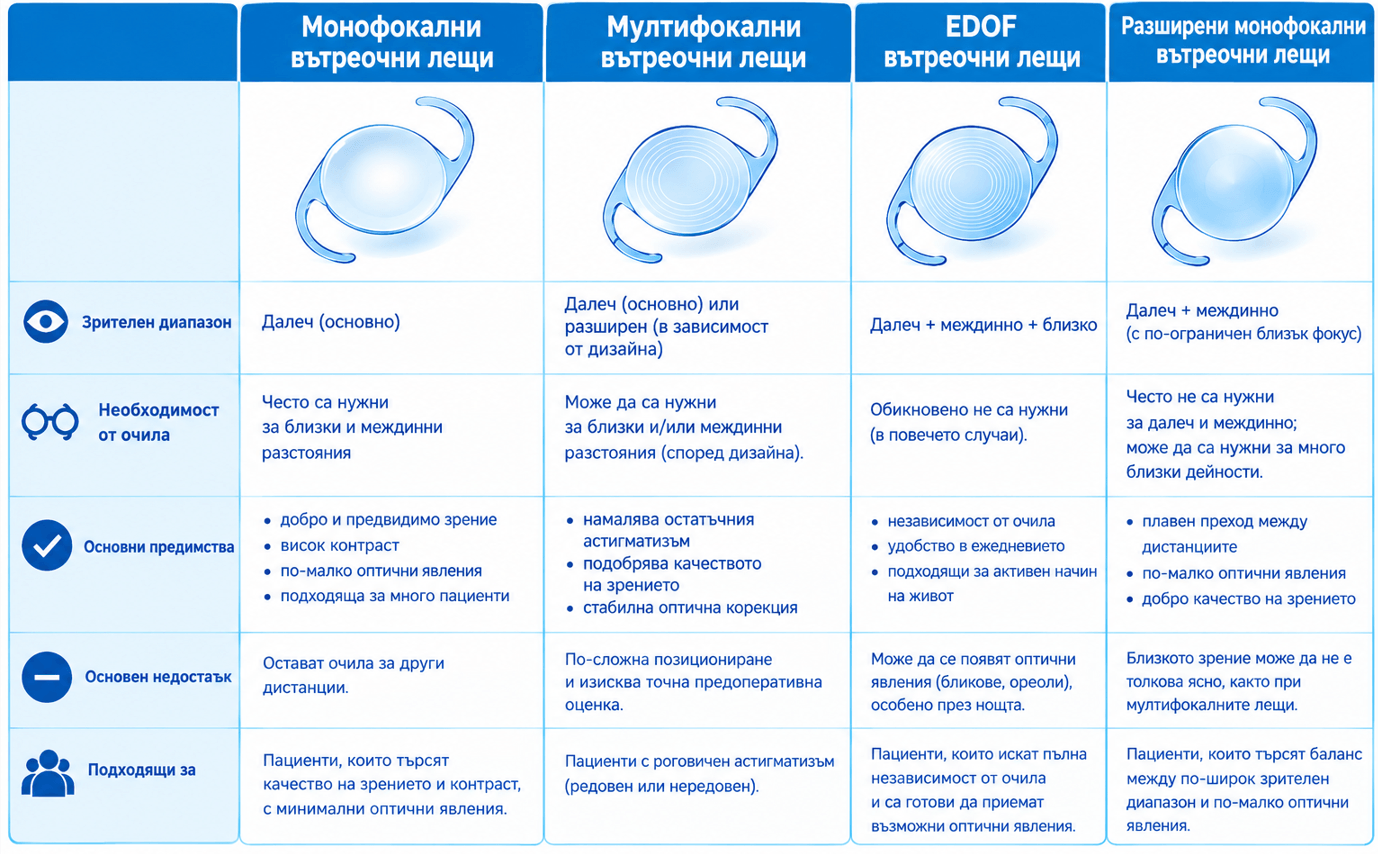
This comparison is for general guidance. The actual result depends on the specific lens model, the characteristics of the eye, preoperative measurements, and the chosen vision goal.
How to choose an intraocular lens: 10 questions to ask your ophthalmologist
Before surgery, it is helpful to discuss:
1. What vision goal is best suited to my eye?
2. Will I need reading glasses?
3. What will my intermediate vision be like when working on a computer?
4. Do I have corneal astigmatism?
5. Is a toric lens suitable for me?
6. Am I a good candidate for an EDOF or multifocal lens?
7. What is my risk of halos and glare?
8. What can I expect when driving at night?
9. Is there a condition affecting the retina, macula, cornea, or ocular surface that needs to be taken into account?
10. How likely am I to need glasses after surgery?
What is a “secondary cataract”?
The term “secondary cataract” is often used by patients, but it does not actually refer to the artificial lens becoming cloudy again.
Months or years after surgery, the posterior capsule that remains around the implanted IOL may develop fibrous tissue. This condition is called posterior capsule opacification (PCO).
It can cause vision to gradually become cloudy.
When posterior capsule opacification is confirmed, the usual treatment is a brief laser procedure called YAG laser capsulotomy.
Conclusion
In cataract surgery, choosing an intraocular lens is just as important as proper preoperative planning.
There is no universally best IOL. The most suitable lens depends on:
· the health of the eye;
· the cornea, macula, and retina;
· whether astigmatism is present;
· lifestyle;
· work and computer use;
· driving, especially at night;
· the need to read;
· the desire for independence from glasses;
· willingness to accept certain optical phenomena;
· the patient’s realistic expectations.
The modern approach to choosing an IOL is not simply to look for the “most advanced” lens, but to find the best balance between quality of vision, range of vision, independence from glasses, and the likelihood of unwanted optical phenomena. Current European recommendations also emphasize individualized selection and shared decision-making between the patient and the ophthalmologist.
If you are considering cataract surgery, discuss with your ophthalmologist not only what lens can be implanted, but also how you want to see after surgery. This vision goal is the foundation for making the right choice.
Important: This article is for informational purposes and does not replace an eye exam or an individual medical consultation. The choice of intraocular lens is made by an ophthalmologist after a thorough examination, the necessary measurements, and a discussion of individual visual goals and risks.
You can schedule a consultation with an ophthalmologist at Pentagram Medical Center by calling 0700 911 91. Or use this link:

Most Serious Diseases Can Be “Read” First Through the Eyes
Eye stroke and retinal damage caused by high blood pressure. Ophthalmologist Dr. Tonya Bozeva explains how to protect our vision.
Read More
Pentagram Eye Hospital Announces Free Ophthalmological Examinations on July 4 and 5, 2025
Free ophthalmological examinations will be conducted on July 4 and 5, 2025 (Friday and Saturday) at the new building* of.
Read More