

Dr. Dryanovska: It is a dangerous myth that the risk of heart attack decreases in summer

Summer is a blessed season that we all look forward to throughout the year. But along with pleasure and joy, it also brings risks to the cardiovascular system, especially for people with high blood pressure, who need to be particularly careful when traveling by car or vacationing at the seaside or in the mountains. This is explained by Dr. Dimitrina Dryanovska, a cardiologist with over 33 years of experience and a member of the team at Pentagram Medical Center.
We talk to her about the main risks associated with high temperatures and how to recognize the first symptoms of heat stroke or a cardiovascular event.
Dr. Dryanovska, what are the most common mistakes people make in summer?
The most common mistake is underestimating the intense sun and high temperatures and going out during peak hours. People often sharply increase their physical activity or drastically change their eating and drinking habits while on vacation. Another serious mistake is stopping or reducing prescribed medication on their own, simply because their blood pressure has dropped due to the heat.
Why does this season become a challenge for the cardiovascular system?
In response to high temperatures, the body tries to cool itself through vasodilation (widening of the blood vessels) and heavy sweating. This makes the heart beat faster to pump more blood to the body’s extremities, while the loss of fluids and electrolytes further thickens the blood and strains the heart muscle.
Who is most at risk during the summer heat—is it only older adults and patients with heart disease?
They are certainly in the highest-risk group, but they are far from the only ones. Young children, pregnant women, people with chronic kidney, endocrine, or neurological diseases, and young people who do heavy physical labor or intense sports training outdoors in the heat are also at risk.
How much water should we drink when it is very hot outside, and can drinking too much fluid be dangerous, as dehydration can?
For a healthy adult, the optimal intake is approximately 2.5 liters per day (about 30–35 mL per kilogram of body weight). Dehydration is extremely dangerous, but for patients with heart failure or severe kidney disease, excessive water intake can lead to increased plasma volume, fluid retention, pulmonary congestion, and dilution of vital electrolytes (such as sodium). These patients must strictly follow the individual fluid limit set by their cardiologist.
What should someone do if their blood pressure starts to drop more than usual in hot weather, and do patients with high blood pressure or heart failure need medication adjustments during the summer?
When blood pressure drops occasionally (hypotension), it is important to lie down, elevate the legs, and drink a glass or two of water or an electrolyte solution (such as ayran). Medication adjustments are often needed because blood vessels naturally dilate in the heat, but they should only be made after consulting a cardiologist, not on one’s own. An adjustment should not involve stopping medication therapy altogether. Initially, only the medication doses are reduced. In patients taking several blood pressure medications, one medication may be discontinued. But this must be done at the discretion of a cardiologist, who is best able to assess the patient’s condition and accompanying risk factors, and never on one’s own.
Is it necessary to measure blood pressure more often during the summer months, and who should do so?
Yes—in the morning and evening, while at rest, and also at other times if dizziness, fatigue, or a headache occurs. This applies to people with diagnosed cardiovascular disease.
What precautions should people with cardiovascular disease take when traveling to the seaside or the mountains?
They should always carry a sufficient supply of their regular medications and up-to-date medical records. At the seaside, they should only spend time on the beach in the morning and late afternoon. In the mountains, steep, overly strenuous routes and elevations above 1500–2000 meters should be avoided without prior acclimatization.
Are there risks associated with a sudden change in climate or a long car journey?
A sudden change in temperature (for example, from a heavily air-conditioned car to 40-degree heat) causes blood vessels to spasm, which can trigger a vascular crisis. During a long journey spent sitting in one seat, blood circulation slows, increasing the risk of venous stasis (blood pooling in the veins) and thrombosis. Therefore, breaks to move around and hydrate should be taken every 1.5–2 hours.
Is it true that the risk of heart attack decreases in the summer, or is that a myth?
This is a dangerous myth. Although heart attacks in winter are often associated with blood vessels constricting in the cold, in summer, the combination of dehydration, blood thickening, and heat stress creates the perfect conditions for blood clots and myocardial infarction.
Is there a link between dehydration and the risk of heart attack, stroke, or blood clots?
The link is direct and proven. When a person is dehydrated, plasma volume decreases and blood viscosity (“thickness”) increases. Combined with physical inactivity (reduced movement), this significantly slows blood flow and makes platelets more likely to clump together, directly increasing the risk of vascular events: heart attack, stroke, and deep vein thrombosis.
What signs should we not ignore on hot days? When is the body’s response normal, and when should we seek medical attention?
Light sweating and barely noticeable fatigue are normal adaptive responses. However, severe dizziness, confusion, nausea, cold and clammy sweat, a rapid and weak pulse, nausea and vomiting, or diarrhea are signs of heat exhaustion. If there is chest pain, tightness, or heaviness, shortness of breath, or fainting, call an ambulance immediately.
If someone experiences severe chest pain or shortness of breath during the hottest part of the day, what should they or those around them do first while waiting for medical help to arrive?
In this situation, you should:
- Call an ambulance immediately (tel. 112).
- Move the person to a cool, shady, well-ventilated place.
- Place them in a semi-seated position (not lying completely flat) and loosen any tight clothing.
- Make sure they have fresh air, cool their forehead and chest with wet towels, and stay calm.
If you had to give three top tips for a healthy heart in the summer, what would they be?
First, I would recommend moderation and shade: avoid direct sun during the hottest hours.
Second, smart hydration: drink water regularly in small sips and avoid ice-cold drinks, alcohol, and excessive amounts of caffeinated beverages.
My third recommendation is caution with medications: do not change your treatment on your own, and monitor your blood pressure.
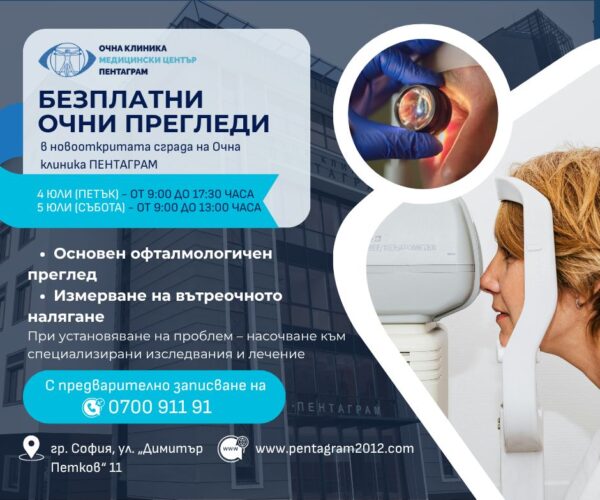
Pentagram Eye Hospital Announces Free Ophthalmological Examinations on July 4 and 5, 2025
Free ophthalmological examinations will be conducted on July 4 and 5, 2025 (Friday and Saturday) at the new building* of.
Read More
Free Eye Exams for First Graders at Pentagram Eye Hospital and Medical Center from September 15 to 30, 2026
To mark the beginning of the school year, Pentagram Eye Hospital and Medical Center is offering free eye exams for.
Read More